Progress Towards Local Government Reorganisation in Surrey
Surrey is undergoing one of the largest changes to its local government structure in its history. Last year, the Government unilaterally decided that Surrey’s existing county council and 11 district and borough councils should be reorganised into two new unitary authorities: West Surrey Council and East Surrey Council.
A Key Milestone Reached
A major milestone in the reorganisation process was reached in January 2026, when councillors from across Surrey met for the first time in two new bodies created to oversee the transition.
- The East Surrey Voluntary Joint Committee met on Thursday 15 January 2026 at Surrey County Council’s offices in Reigate.
- Chair: Cllr Bridget Kendrick (Mole Valley District Council)
- Vice Chair: Cllr David Lewis (Surrey County Council)
- The West Surrey Voluntary Joint Committee met on Friday 16 January 2026 at Woking Borough Council.
- Chair: Cllr Anne-Marie Barker (Woking Borough Council)
- Vice Chair: Cllr Robert King (Runnymede Borough Council)
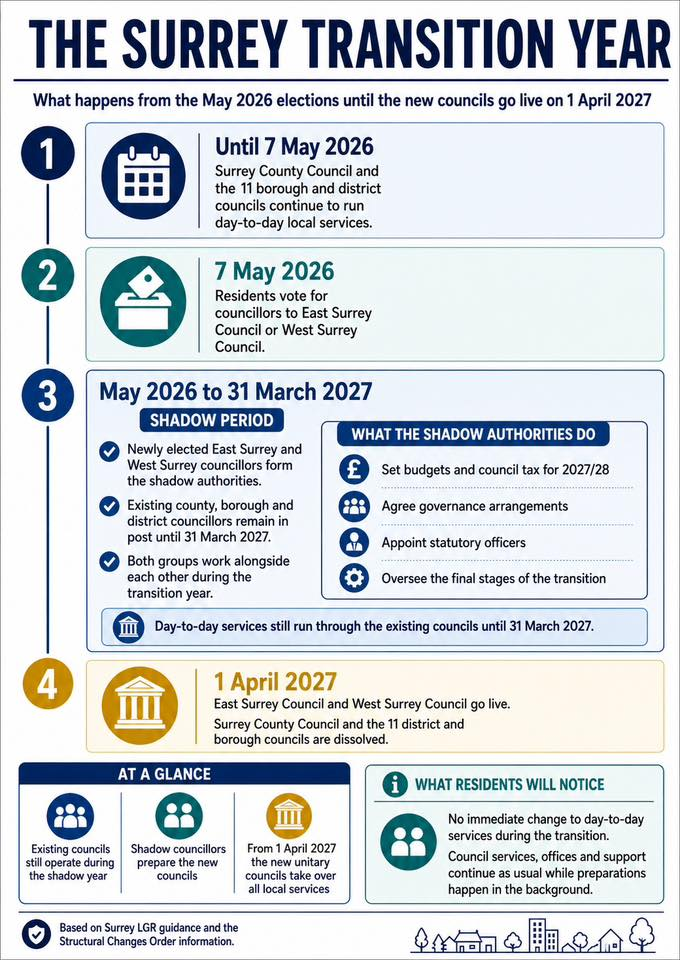
Both committees will now meet monthly, rotating their meetings around their areas, until the new shadow authorities are formed following elections in May 2026.
Why the Joint Committees Have Been Formed
Local government reorganisation is a large and complex programme. The Voluntary Joint Committees have been created so that preparation work can begin. They are made up of councillors who have already been elected to Surrey County Council and the district and borough councils, and who are now working together to organise the two new unitary councils.
Membership of the Voluntary Joint Committees
East Surrey Voluntary Joint Committee – Elected Members
- Cllr Mike Rollings – Elmbridge Borough Council (Claygate)
- Cllr Hannah Dalton – Epsom and Ewell Borough Council (Stoneleigh)
- Cllr Bridget Kendrick – Mole Valley District Council (Leatherhead South) – Chair
- Cllr Richard Biggs – Reigate and Banstead Borough Council (Horley West and Sidlow)
- Cllr Natalie Bramhall – Surrey County Council (Redhill West and Meadvale)
- Cllr Helyn Clack – Surrey County Council (Dorking Rural)
- Cllr Stephen Cooksey – Surrey County Council (Dorking South and the Holmwoods)
- Cllr David Lewis – Surrey County Council (Cobham) – Vice Chair
- Cllr Steven McCormick – Surrey County Council (Epsom Town and Downs)
- Cllr Catherine Sayer – Tandridge District Council (Oxted North)
West Surrey Voluntary Joint Committee – Elected Members
- Cllr Julia McShane – Guildford Borough Council (Westborough)
- Cllr Robert King – Runnymede Borough Council (Egham Hythe) – Vice Chair
- Cllr Joanne Sexton – Spelthorne Borough Council (Ashford East)
- Cllr Matt Furniss – Surrey County Council (Shalford)
- Cllr Mark Nuti – Surrey County Council (Chertsey)
- Cllr Catherine Powell – Surrey County Council (Farnham North)
- Cllr Lance Spencer – Surrey County Council (Goldsworth East and Horsell Village)
- Cllr Liz Townsend – Surrey County Council (Cranleigh and Ewhurst)
- Cllr Denise Turner-Stewart – Surrey County Council (Staines South and Ashford West)
- Cllr Shaun Macdonald – Surrey Heath Borough Council (Lightwater)
- Cllr Paul Follows – Waverley Borough Council (Godalming Central and Ockford)
- Cllr Anne-Marie Barker – Woking Borough Council (Goldsworth Park) – Chair
All of these councillors have been elected to their current roles and are serving on the Joint Committees to help establish the new councils.
What Happens Next
In May 2026, residents across Surrey will vote for councillors for the new West Surrey Council and East Surrey Council. Those elected will initially form shadow authorities, which will take over the work of setting up the new organisations from the Voluntary Joint Committees.
From April 2027, the shadow authorities will formally become the new unitary councils and will assume responsibility for delivering all local government services.
Changes in Representation
At present, Surrey has:
- 81 county councillors
- 453 district and borough councillors
- Total: 534 councillors
Following reorganisation:
- West Surrey will have 90 councillors
- East Surrey will have 72 councillors
- Total: 162 councillors
Councillor Allowances
County councillors currently receive an allowance of £14,160 per year, with district and borough councillors receiving varying amounts. These allowances recognise the time commitment and costs involved, including meetings, office expenses, travel, casework, and community engagement.
Financial Context
The Government has confirmed its commitment to repay £500 million of Woking Borough Council’s debt in 2026–27. This represents the first tranche of support, with further assistance to be considered as the reorganisation progresses.
Local Government Reorganisation and Devolution
The Govenment has decided that there will be only two new unitary councils in Surrey, despite a clear majority of all responses to the consultation – from the public, businesses, voluntary groups, councillors and councils themselves – favouring the three unitary option. So there will be no North Surrey, just East and West, with Elmbridge (Walton, Weybridge, Molesey, Esher and Cobham) joining Epsom & Ewell, Mole Valley, Tandridge – and Reigate & Banstead in East Surrey.
The Minister said that both the two and three unitary options meet their criteria of the new councils being “right-sized for efficiencies, improved capacity and ability to withstand financial shocks and delivery of high quality public services etc”. The Minister went on to say that he ruled in favour of the two unitaries on financial grounds “in the unique context of Surrey where reorganisation is a critical intervention to improve financial viability”. He is talking about Woking, and to a lesser extent Spelthorne and Runnymede, which have significant debts. In Woking’s case, he committed the Treasury to writing off £500 million of Woking’s unsupported debts of over £2 billion, which he highlighted as “significant and unprecedented”.

No doubt other councils around the country will be lining up with their begging bowls – as a reminder we in Reigate & Banstead have no borrowings whatsoever. However, in truth, the Minister had little option, as the new West Surrey Council would have gone immediately into bankruptcy without this write off.
Next year, in May 2026, there will be elections to the new East Surrey Council. That new council will operate in “shadow” form, appointing its new leader, chief executive and senior officers and getting ready to take over on 1 April 2027.
Until that day, Surrey County Council and Reigate & Banstead Borough Council continue to be fully responsible for all our services. Clearly a lot of work has started to look how services in the boroughs can be joined together and look for savings. And conversely, at the county level on how to separate the current combined services. As the county spends six times as much as the boroughs, there will be a lot of work trying to ensure the system doesn’t become less efficient and more costly.
It had been expected that elections for an overall elected mayor in Surrey would be held in May 2027. The Government has squashed that notion as they are too busy reorganising the remaining shire councils. This mayor (unlike the civic mayors we currently have) would have similar powers to Mayor Khan in London. Responsibilities would include running the police and fire service, overall transport and planning responsibilities and economic regeneration. This is disappointing in particular for Cllr Tim Oliver who had his eyes on a pot of redevelopment funding from government and this had led him to volunteer for early reorganisation of local government in Surrey. There is now no fixed date for mayoral elections.
A local government expert from the London School of Economics has said that the benefits case for this reorganisation is unproven, but the result will be to facilitate planning and growth. The new council will serve well over half a million people. He pointed out there will be a very low number of councillors and local representation per head of population which will lead to “one of the most democratically unrepresented areas in Europe.”
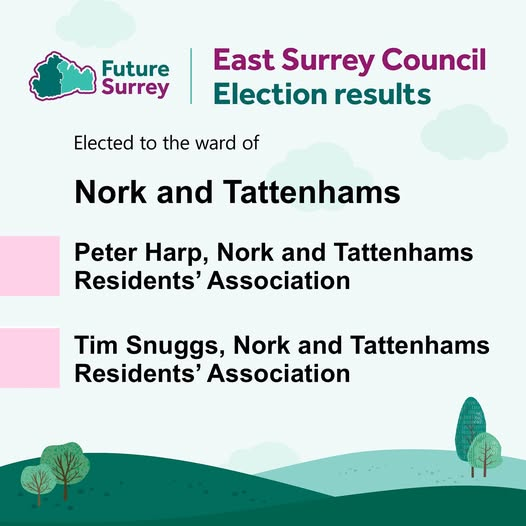
Local representation will shrink from seven councillors to two. The wards for the new council will be based on the current electoral boundaries for county council elections. There will be two councillors elected for the Nork and Tattenhams area, but the Preston part of our area (south of Chetwode Road) will be aligned with Tadworth, Walton & Kingswood, where there will also be two councillors.
The government continues to call its new arrangements as devolution, when it seems to in fact be moving in the opposite direction – moving decision making upwards to larger bodies. One of the government’s stated aims in the reorganisation
is to “enable stronger community engagement and deliver genuine opportunity for neighbourhood empowerment.” It is to take advantage of such opportunities that the councils in East Surrey are offering the possibility of local councils (parish and town) compensating for the emerging democratic deficit.
Banstead and The Villages Council
What is a Local Council?
Local Councils are often known as Town or Parish Councils and operate with elected volunteer, unpaid councillors. There are already 85 such councils in Surrey, mainly in the rural south; in Reigate & Banstead we have a Town Council in Horley and a Parish Council in Salfords & Sidlow. Local Councils are now being proposed across most of the towns and suburban areas closer to London – for example in Epsom & Ewell and Mole Valley. There have been similar moves In other counties – for example in Cornwall and Somerset – which are already unitaries.
Town Councils and Parish Councils – collectively Local Councils – are effectively all the same and different in name only. They have the same powers. Town Councils tend to operate in urban areas and have larger populations; they may have a town mayor too. Parish Councils tend to operate in rural areas and have a smaller population. Parish Councils are civil councils and completely different from a church parish.
Proposal
It is proposed to set up a Local Council north of the M25 to be known as “Banstead and The Villages Council”. Besides our ward it would include Banstead Village itself plus Tadworth, Walton, Kingswood, Chipstead etc. and would have 40,000 electors. Smaller parish councils for individual wards have been rejected as too small to be effective and would be relatively costly per head to run.

What does a Local Council do?
- A Local Council could be important in development and planning applications, ensuring focus is given to the new grey belt designation of our countryside. It could make well thought through representations to the planning department of the unitary council as the powers of individual councillors on planning committees are expected to reduce, operating in an environment where housing targets are being more than doubled.
- Local Councils can improve the quality of life, often providing “first level” truly local services, such as community halls, allotments, playgrounds, parks, pavilions and more. They can help argue for and protect services which the new unitary council might consider reducing or removing altogether.
- A Local Council has a statutory right to 15% of the Community Infrastructure Levy (CIL) charged on all new development. This “Local CIL” could be used to pay for local initiatives.
Of course all this has to be paid for, and any additional council tax levy would have to be very carefully considered. In Horley there is a refund agreement with Reigate & Banstead to pay for some services, avoiding double taxation. As a comparison the annual Band D equivalent charge for Salfords & Sidlow is £33 and for Horley (which has a wider range of services) is £55. The cost for us would depend on the services residents want the Council to provide.